Is My Skincare Routine Too Complicated?
A routine is too complicated when you can't clearly say what each step is for, when steps quietly duplicate each other, or when you can no longer tell what changed after adding or dropping something — not simply because it has many steps.
Complexity isn't about the number of steps
A routine with eight carefully chosen steps, each serving a distinct role, can be easier to manage than a four-step routine where you're not sure what each product is actually doing. The signal to look for isn't length — it's clarity.
Sign 1: Duplication you didn't notice
Over time it's common to accumulate more than one product covering the same role, especially after switching brands without removing the old one. If you lined up your products and grouped them by actual purpose, would any group have more than one item in it?
Sign 2: You can't say what changed
If you added or removed something recently and can't clearly connect it to a specific reason or a specific result, that's a sign the routine has outpaced your ability to track it. This isn't about diagnosing a reaction — it's simply about whether the routine is legible to you.
This is where dated, before-and-after comparisons help more than memory does. Skin Journey in Visage AI keeps measured results attached to dates, so you're comparing against an actual record instead of a recollection.
Sign 3: Steps with no clear purpose
Ask, honestly, why each product is in your routine. "It was recommended" or "I've always used it" aren't roles — they're history. A step that can't be tied to a current purpose is a candidate to simplify, not because it's doing harm, but because it isn't doing an identifiable job.
What this isn't
None of this is meant to diagnose irritation, sensitivity, or any skin condition — that's a matter for a dermatologist, not a routine check. This is about whether your routine is legible and intentional, which is a separate question from whether your skin is reacting to something.
Frequently asked questions
Does a complicated routine cause skin problems?
That's not something a routine check can tell you — irritation and skin reactions are medical questions best handled by a dermatologist. What a routine check can tell you is whether your steps are clear, non-duplicated, and purposeful.
How many products is too many?
There isn't a universal number. The more useful check is whether every product has a distinct, current role — a routine can be long and still be clear, or short and still be confusing.
What's the easiest first step to reduce complexity?
Identify genuinely duplicated roles first. Consolidating genuine duplication can preserve the intended role while reducing complexity.
Get a clear read on what you're actually using
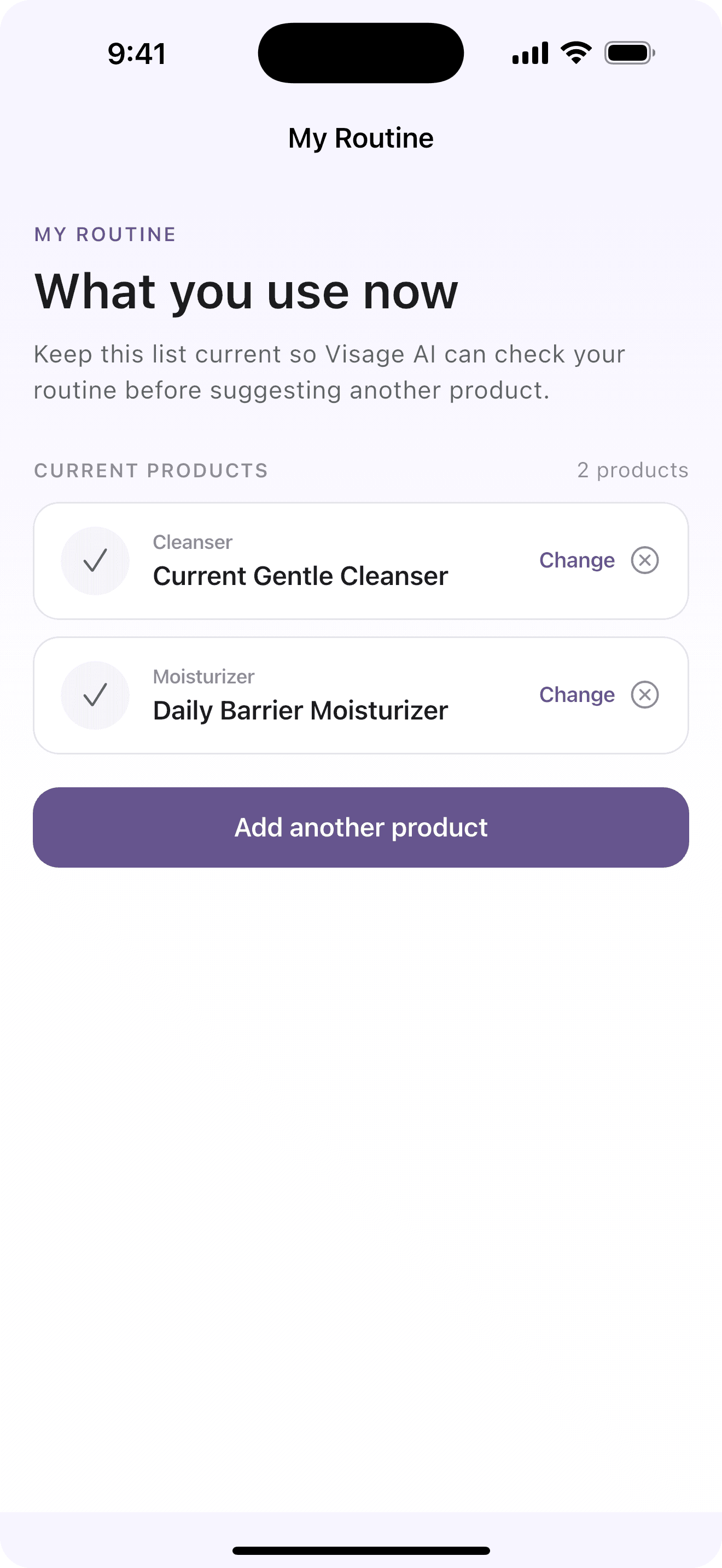
Visage AI lays out your current routine and priority in plain terms, so you can judge complexity from clarity, not guesswork.